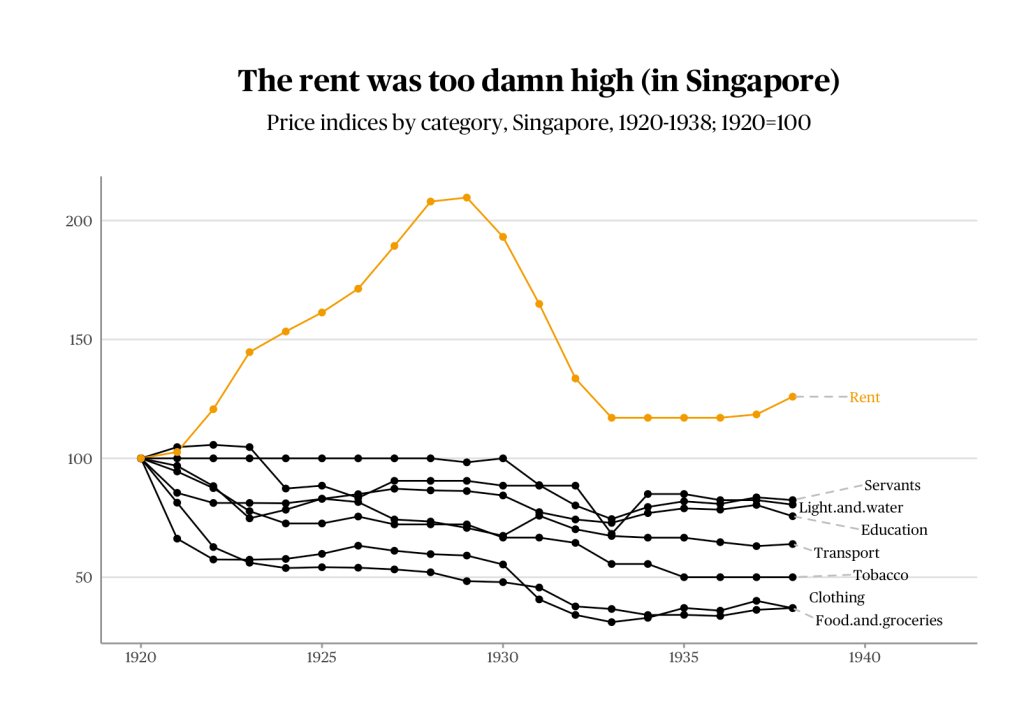
As my more devoted readers know, I am very interested in the relationship between housing costs and historical living standards and have shown that incorporating estimates of housing costs in a measure of the real wage in colonial Dakar makes a substantial difference to the story. I’m trying to accumulate more evidence for the proposition that housing costs matter, and in particular the proposition that housing costs likely swallow up a substantial fraction of the increase in real urban income in cities in developing countries where housing supply is relatively inelastic. One part of the developing world which is relatively easy to demonstrate this for, it turns out, is colonial Singapore, for which the British authorities compiled a set of price indices that were disaggregated by category. Choy and Sugimoto, in their study of real wages in Singapore, seem not to make use of this index, though they use the weights from the overall price index to slightly bump up the rental share of the consumer basket they use to construct their own price indices. They find a generally stagnant real wage for unskilled workers in Singapore, even during the rubber boom of the 1920s, though a very pronounced increase in the real wage for skilled labourers.
Interestingly enough, this is the decade when housing prices diverge considerably from other prices. Housing costs roughly doubled from 1920 to 1930, while the prices of more or less every other part of the consumer basket fell. Nominal housing costs plummeted at the onset of the Great Depression but never reached their level in 1920. The exact effect on the unskilled real wage in Singapore is hard to quantify because Choy and Sugimoto’s data isn’t yet publicly available and I’m not going to reconstruct it just for a blogpost, but probably would not be extraordinarily large: if we take the initial (1914) CPI weights as accurate, then housing was about 6% of total expenditure in 1920, increasing to about 18% of expenditure in 1929. While it represents a tripling of housing’s share of expenditure over the course of a decade, the difference in the overall index would not be all that different if we removed housing from it. If we calculated a housing-exclusive CPI, the decline from 1920 prices would be about 35 percentage points by 1929, whereas the decline is only 25 percentage points if we include housing. But this is really a function of the low initial weight, based, presumably, on a household budget study about which we know very little. And as I will argue in a blogpost very soon, there might be a reason to doubt the low housing shares that many household budget studies give to housing, at least in developing countries.
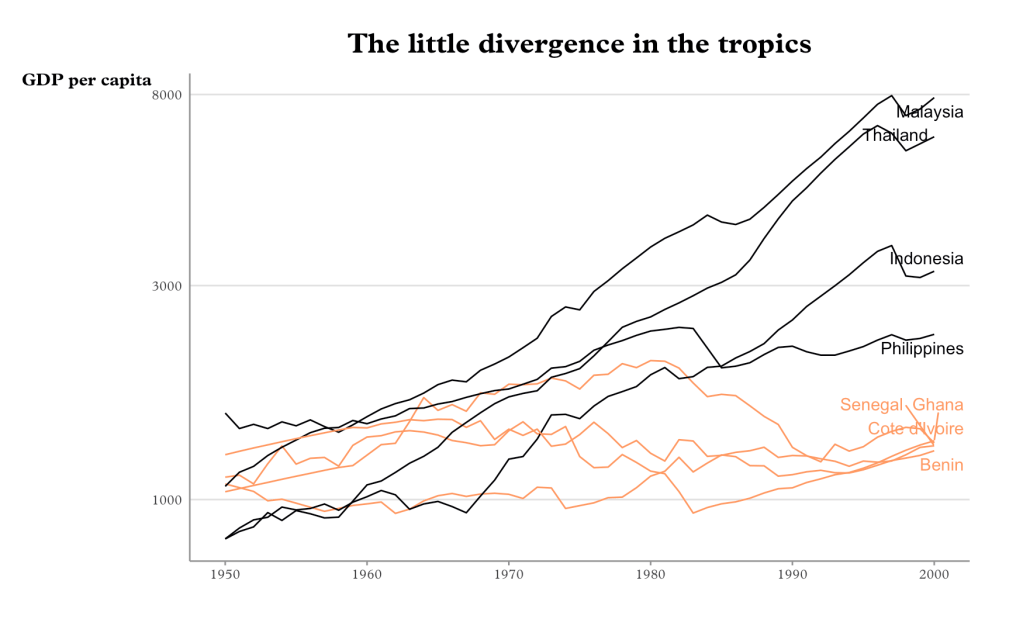
One of the less remarked upon ‘divergences’ in the economic history literature is the ‘Little’ Divergence between West Africa and Southeast Asia in the twentieth century. Up until around the 1970s, the differences in income between the two regions were not large. But after that point, Southeast Asia grew much quicker. Some Southeast Asian countries—Laos, Cambodia, Myanmar—have followed a more ‘West African’ path, but broadly speaking the divergence in striking.
There is no single explanation for the divergence. One is simply the existence of Japan, which seeded low-wage industries in which it was no longer competitive to Southeast Asia with foreign investment: the so-called ‘flying geese‘ pattern. Since there was no equivalent to Japan in West Africa, industrial capital came mainly from limited domestic sources, and former European colonial powers, neither of which succeeded in implanting cost-competitive manufacturing.
One of the industrialising problems West Africa and Southeast Asia faced together was their relatively high wages, which in turn were the result of abundant land and scarce labour. This factor combination led to a high reservation wage, since farmers could essentially choose to farm as much land as they liked rather than work for low wages in an urban factory. There are some qualifications to be made here—in my latest working paper I offer some scraps of evidence from colonial Dakar to show that nominal wages were highly seasonal, thus making the city ‘Myintian in the rainy season; Lewisian in the dry’. Similarly, in parts of Southeast Asia a low-wage population for plantation labour and urban unskilled work was recruited from China and India, which were land scarce and labour abundant. But overall, it is not wrong to characterise large parts of West Africa and Southeast Asia as forming a ‘land-abundant, high wage’ tropical zone.
What is the problem with high wages? Well, high nominal wages are related a country’s export competitiveness in the export sector, since they are one element of unit labour costs (i.e., how much a business has to pay its workers in order to produce $1 worth of output; ULCs are therefore a product of the nominal wage and labour productivity). But of course there can be a divergence between nominal wages and real wages. We could state a food price dual objective of a developmental state in a land-abundant economy: push real wages high enough to attract workers from farm to factory, but keep nominal wages low enough that output is competitive in world markets. One way to fulfil the dual objective would therefore be to keep food prices low. (The same incentives might apply to extractive or nightwatchmen-type colonial governments as to developmental states: nominal wages formed a large share of colonial budgets, while most colonial governments were more afraid of urban unrest, so a strategy of trying to keep nominal wages low and real wages high might have made political sense for them as well). That said: wages aren’t everything. A while ago, an Australian mining billionaire warned my country that our workers would have to socialise and drink less because they were competing with workers in West Africa who were paid $2 a day. Australians still drink as much as they did in 2012, are still paid very high wages by world standards, and we still export a lot of iron ore. But in an economy that is land-abundant and mainly agricultural, and in which urban manufacturing is likely to be labour-intensive, urban wages are likely to be closely linked to agricultural productivity, and to weigh more heavily on the balance sheets of factory owners than in more capital-abundant countries.
Hence why economic history’s Twitter pope, Pseudoerasmus, asks: should we consider whether food prices act as a constraint on African industrialisation? Labour costs in Africa are high. The price of food in Africa is also high. This is true if we compare the price of the same good in African cities and the US, or if we instead compare to countries at the same level of GDP as the African ones. Thomas Allen calculates that “food prices in sub-Saharan Africa are 30 to 40% more expensive than in the rest of the world at comparable levels of GDP per capita”. Alan Gelb and Anna Diofasi show this in a simple graph (excuse the Stata aesthetics on a religiously R-friendly blog; their chart not mine):
This relationship is quite striking. Allen plots a similar graph, highlighting Asia and the Pacific as well, where food prices seem to be below what one might expect given levels of GDP per capita:
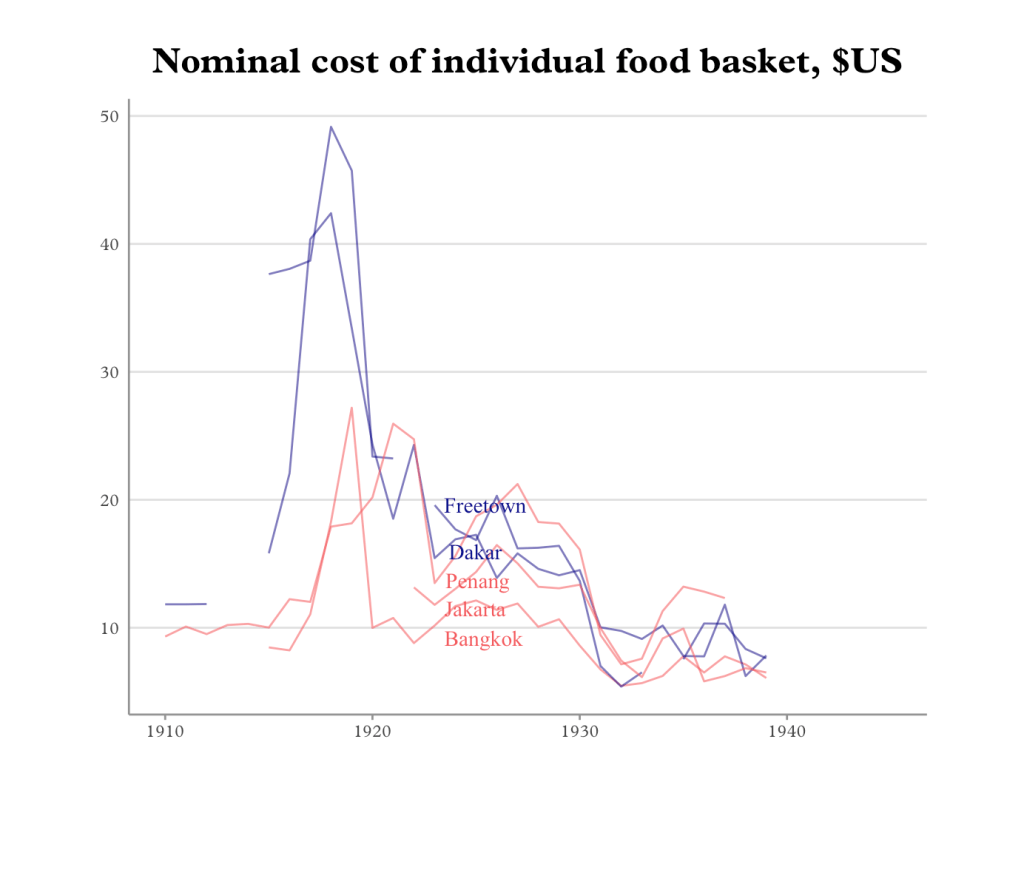
Have African food prices always been higher than in the rest of the world, reflecting some fundamental aspect of their economies, or is it a relatively new phenomenon? To investigate this question I will look at food prices in five tropical cities in the first half of the twentieth century: Dakar and Freetown, in West Africa, and Jakarta, Bangkok and George Town (Penang) in southeast Asia. I take a price series I collected for Dakar and Ewout Frankema and Marlous van Waijenburg’s prices for Freetown, and gather new price series for Jakarta, Bangkok and Penang.
The advantage of choosing these five cities is that all of them were rice-staple cities (i.e., urban unskilled labourers would most likely have consumed large amounts of rice). I can therefore put together a reasonably standard ‘food basket’, that resembles the subsistence basket of the now-standard Robert Allen methodology. That is to say, I calculate the cost of:
184 kilograms of rice (cheapest variety)
3 litres of cooking oil (coconut or peanut oil in Southeast Asia; peanut oil in Dakar; palm oil in Freetown)
3 kilograms of meat (cheapest of fish, beef, pork or mutton)
2 kilograms of sugar
in each city in local currency, which I then convert at market exchange rates to United States dollars. They look like this (the two African cities are plotted in purple and the three Southeast Asian cities are plotted in red). Though it’s a little hard to tell what’s going on, some things jump out: the inflationary period just after the First World War was much more pronounced in West Africa than in Southeast Asia; but the differences were less stark by the end of the Great Depression.
Because this is a bit hard to read, I’ve resorted to something quite aesthetically crude: a colour-coded table. I’ve divided the food basket price in the two West African cities by each of prices in the three Southeast Asian cities, highlighting years where the West African city was more expensive than the Southeast Asian city in red and years when it was cheaper in green:
This table makes it easy to see that generally speaking, Freetown and Dakar were more expensive than the three Southeast Asian towns to which I have compared them, with the exception of Penang, which was somewhat cheaper than Dakar for parts of the 1920s and 1930s.
This evidence, obviously is not conclusive, and I have some more data to collect to flesh out the analysis, but based on series presented above, I’d say that the West African food price problem is not necessarily a recent development, and for that reason it’s worth looking again at the structure of urban food provisioning in West Africa.
Along with coauthors Isabella Weber, Gregor Semieniuk and Junshang Liang, I have a new working paper out at Rebuilding Macroeconomics, drawing on a new database of global commodity-level exports in the period of the ‘first globalization’.
One of my favourite papers from the past 10 years is Gollin, Jedwab and Vollrath’s paper on ‘Urbanisation with and without industrialisation‘. They note the difference between ‘production cities’, where manufacturing dominates, and ‘consumption cities’, where the services sector rules. They connect this with natural resources, and with non-homothetic preferences in consumption: a natural resource boom brings ‘manna from heaven’ (essentially, income without opportunity cost), and this can be spent on food, manufactures or services. As incomes grow, the demand for food grows too, but not in proportion to income. People demand more manufactures and more services. Since manufactures can be imported, consumers purchase manufactures from abroad and services produced domestically.
In a new draft paper, I make new estimates of per capita GDP for the turn of the twentieth century, roughly doubling currently available estimates. One of the advantages of my method is that is produces an estimate for the share of agriculture in GDP. I can then estimate two things: the compound annual growth rate of GDP per capita across the twentieth century, and the decline of agriculture’s share of GDP (in percentage point) across the same time period. I graph these separately, and highlight African countries in yellow:
The results are startling: agriculture is a much lower share of African countries’ GDP in 2000 than in 1900, but these countries have witnessed much slower GDP growth in the 20th century. Perhaps the most astonishing country, though, is Burma, which actually became more agricultural over the course of the century, as well as witnessing a negative annual average growth rate. I take these results as fairly good evidence for ‘urbanisation without industrialisation’, but with a caveat: some of the countries that have witnessed slow growth have urbanised without natural resources, especially in Africa.
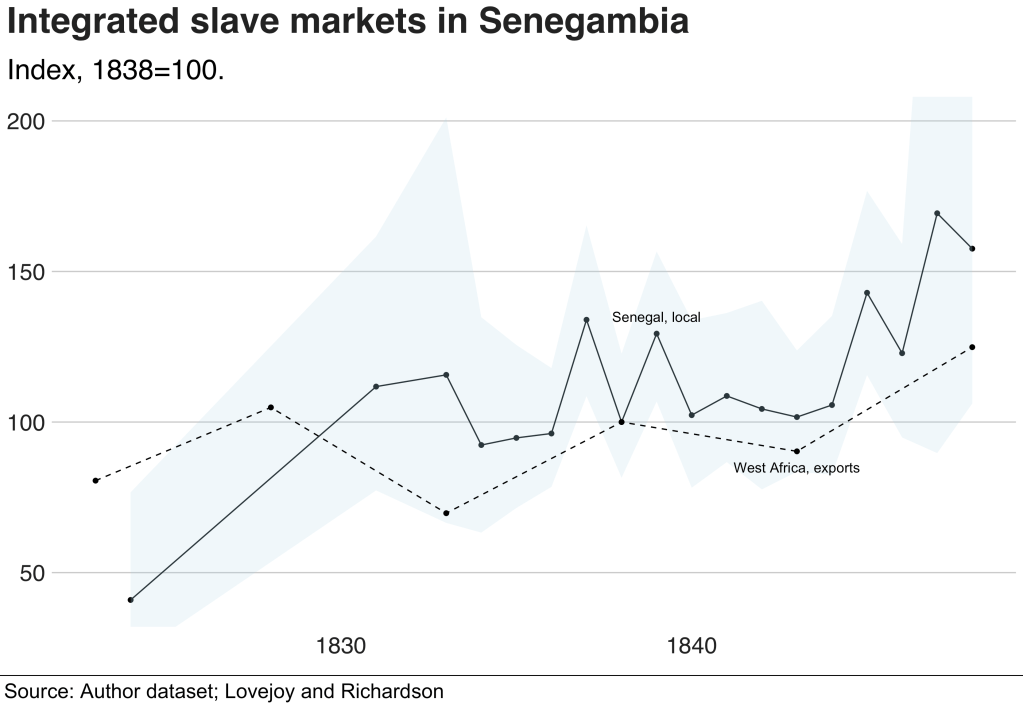
Recently Martin Klein wrote an interesting article suggesting that the functioning of urban slave labour markets in Africa require more theorising, and (fortunately, since a chapter of my dissertation is on precisely this subject) I agree. One question worth exploring is a subset of the more broader question of market integration: were domestic African markets for enslaved labour integrated with the broader trans-Atlantic slave trade? Paul Lovejoy and David Richardson argued about twenty-five years ago that they were integrated, rejecting Emmanuel Terray’s thesis that they were two essentially distinct and unconnected markets. But Lovejoy and Richardson’s conclusion was based on a very sparse dataset, based entirely on observations from European travellers. One of the findings of my own work is that at least in European coastal enclaves, like Saint Louis and Gorée in Senegal, real slave prices in the domestic slave market moved in tandem with coastal prices in the transatlantic slave trade. As Bronwen Everill has argued, these Afro-European towns were very much part of a broader Atlantic economy, and price history can help us demonstrate this:
I’ve just added a new dataset, documenting the evolution of the real wage in colonial Dakar. I’ll add a more detailed documentation soon, but the major sources come from archival material in the Senegalese national archives.
Via a rather circuitous route, I’ve become extremely interested in domestic market integration: basically, I was thinking about the way we measure agricultural output in the past. Often, it’s a version of what we might call the “Malanima shortcut”; though he wasn’t the first to use the idea of a demand function to estimate agricultural output, his application to Italy is probably one of the best-known uses of the trick. The way it works it basically just to assume a demand function for food: y = f (food prices, other prices, income). This function is often abbreviated to simply y = f (income). If you have a time series of real wages—serving here as a proxy for income— then you can back out the demand for food.
What does this have to do with market integration? Well, consider a country with a rainforest region and a savanna region: in the rainforest region, they grow maize, and in the savanna region, they grow millet. These regions form part of the same country, but they’re not integrated at all: there’s no grain trade between them, so the Law of One Price doesn’t hold. And let’s assume for the sake of argument that the nominal wage in both regions is fixed at $1000. In the first year, there are good harvests of maize and millet, and the price of each is, say, $1/kg. The real wage, in terms of kilograms of grain, is 1000.
Now let’s assume that in year two there’s a terrible harvest of millet and a good harvest of maize. The price of millet shoots up to $2/kg, while maize prices stay the same. The real wage in terms of grain is now 1000 in the rainforest region and only 500 in the savanna! As historical GDP reconstructors, this decline in the real wage (caused by a spike in millet prices) is a very strong indication of a bad harvest. But if all we have access to are maize prices, and hence real wages from the rainforest region, we will have no way of knowing about the terrible millet harvest. If there were free and costless trade between the two regions (and only these two regions), this wouldn’t be a problem: the price of maize in the rainforest region would also rise, because of an increase in demand caused by the price increase for its substitute in consumption, millet, and our demand function would account for it. But if markets aren’t well-integrated, then there’s no reason to suppose that the maize-denominated real wage in Rainforest can tell us anything about the agricultural output of Savanna.
So the integration of markets matters! And it’s not an understudied topic in economic history. A lot of work has been done on this question in Europe and North America, obviously, but also in India and China. Interestingly, one bit of low hanging fruit hasn’t been plucked, as far as I can tell, so I went ahead and plucked it: British Burma, for which grain prices are given the standard Prices and Wages in British India compendia. Because most previous discussions of market integration in British India have focused on the railway system, to which British Burma was not connected, they seem to have omitted Burma. But Burma is well-worth studying on its own, because and not just because it became one of the most important ‘rice-bowls’ of Asia in the colonial period. So I did some transcribing.
Obviously, there are a lot of fancy econometrics on market integration one can perform that I haven’t yet, but here is the coefficient of variation (the standard deviation divided by the mean. I only used towns with data for all years from 1861-1917, meaning that coverage is limited to the Megui Islands, Dawei, Mawlamyine, Rangoon, Pathein, Pyay, Taungoo, Thayet, and Kyaukpyu. So what happened in the mid 1870s? The Rangoon–Pyay railway was opened in 1877, and at first blush seems to have had a major influence in driving price convergence across Lower Burma.
Over the last ten years wehavelearnt a lot about living standards in the developing world. I won’t attempt to summarise every single paper here. Mostly these have come from a reconstructions of real wages, one of the easiest economic statistics to reconstruct in historical periods: all you need is information on the nominal wages of unskilled workers and on the prices of the kinds of goods that unskilled workers would buy (mainly grains, and some meat and cloth). To calculate what we might called an ‘Allen welfare ratio’ (after Bob Allen, who pioneered the particular subsistence basket of goods most people now use) you divide the wage by the cost of feeding, clothing and (!) housing a family of two adults and two children. A value of one indicates that a worker’s wage was just enough to purchase the goods necessary for his (almost always his) family to live at a ‘barebones’ level of consumption. One of the interesting findings of the work on African real wages in the colonial period has been that real wages generally improved over the course of the first half of the twentieth century, a result consistent with the idea that the expansion in agricultural commodity production for trade in the developing world increased the standard of living, at least for urban workers.
For example, these are Ewout Frankema and Marlous van Waijenburg’s estimates of real wages in East Africa from 1880–1965.
And, showing similar trends, here are my own estimates for some cities in French Africa (unpublished as yet but hopefully in working paper form soon):
Noticeably, for all of the cities shown here, we observe a rising trend in the last few decades of colonial rule. But as I’ve been working more on my estimates for French Africa, I’ve wondered whether this might not be an artefact of the way we calculate real wages. The method briefly described above—get the nominal wage, deflate it with the cost of a ‘subsistence’ basket of goods—relies in practice on several assumptions. The one that I have been obsessing about relates to housing costs. As a (by First World standards) poor graduate student, I am used to spending a very large fraction of my income on rent: often over 50%. When we calculate these welfare ratios, though, we tend to assume that the cost of a subsistence level of housing is precisely equal to five percent of the cost of all other goods necessary for subsistence consumption. This assumption is a strong one, but by and large it has been accepted due to the difficulty in procuring adequate data to relax it.
Now, there are some conceptual questions that arise here. For example, what is a subsistence level of housing? We can define a subsistence level of grain consumption, because humans have certain physiological requirements for calories and protein, so we can stipulate that, for example, an adult male’s subsistence requirement of rice is 180 kilograms a year. But housing is a lot less easy to define in this way! In a more elaborate paper draft, I use modern microdata from Côte d’Ivoire to try to answer this question in a more theoretically rigorous way, and I generally find that families that we would characterise as living at ‘subsistence’ level (judging either by their income or their food expenditures) tend to spend much more on housing than 5% of their income.
But for now, what I want to show is what happens to estimates of real wages when we use actual historical data on labourer’s monthly rents for housing. The data on rents come from an attempt in the 1950s to draw up a set of national accounts for French West Africa. They give estimates of working class rents for a large number of cities in the colonies concerned, which I’ve combined with a series of real wage estimates for these cities, using archived price and wage data that I found in the Archives nationales du Sénégal in Dakar.
City and colony
Welfare ratio Traditional method
Welfare ratio Actual labourer rents
Ségou (Soudan)
1.1
0.8
Niamey (Niger)
1.3
0.9
Ouagadougou (Haute-Volta)
1.4
0.7
Gao (Soudan)
1.7
1.3
Kayes (Soudan)
1.8
1.2
Thiès (Senegal)
2.1
1.1
Dakar (Senegal)
2.1
1.4
Louga (Senegal)
2.2
1
Kaolack (Senegal)
2.2
1.2
Bamako (Soudan)
2.3
1.4
Kédougou (Senegal)
2.4
1.1
Maradi (Niger)
2.5
1.7
Zinder (Niger)
2.5
1.9
Porto-Novo (Dahomey)
2.9
0.8
Cotonou (Dahomey)
3
1.3
Bobo-Dioulasso (Haute-Volta)
3.1
1.4
These magnitudes are, not to put too fine a point on it, huge. Housing in urban centres in mid-century Africa was extraordinarily expensive when compared to the incomes of unskilled labourers. If we fail to account for housing costs properly in, for example, Porto-Novo (a major city in what is now Benin), we may assume that the standard of living of an unskilled worker was 3 times its actual level!
So how do we make sense of this? First, extremely high rents are probably an indication of poorly functioning housing markets—poorly functioning in the sense that the elasticity of supply of housing to rental yields was low. In turn, this suggests that landlords were enjoying supernormal profits from their investments in urban real estate—that is, profits above the level that would have been required to induce them into building homes in the first place. If this is the case, then our estimates of rising urban incomes in the middle of the 20th century are probably true, but only in aggregate: per capita incomes may have been rising, but they were unequally distributed between those who owned property and those who had to rent or buy it. One is reminded of Mohamed Mbodj’s argument in an old essay that the abolition of slavery in French Senegal in 1848 did not lead to a decline in the dominance of the old slaveholding elite, since slaveholders controlled scarce land and buildings on the islands of Saint Louis and Gorée.
I’m going to blog a bit more about this as work on this paper progresses, but I think the evidence here is enough to suggest that we need to devote a lot more effort to collecting historical data on housing costs in the developing world if we want to understand the long-run evolution of living standards and income inequality.
Part of my thesis is about the role of African cities in structural change in the colonial period, taking the Senegalese city of Dakar as an example. In particular, I look at the occupational attainment of rural-urban migrants compared to people born in Dakar—i.e., what kind of jobs do people get, conditioned on their human capital, their age, their sex and so on. Though this isn’t really the focus of the chapter, the dataset I constructed allows me to look in some detail at social mobility. The data comes from the état civil of Dakar—that is, the civil registration of births, deaths and marriages. I focus mainly on deaths, which frequently records the occupations of men and their fathers. From this data, I can make the following graph, which divides both ‘fathers’ and ‘sons’ into six occupational categories and then shows the flows between each category from generation to generation:
Occupational categories (I) Agriculture (II) Unskilled labour (III) Semi-skilled manual labour (IV) Semi-skilled non-manual labour (V) Skilled labour, non-manual, (VI) Military
It shows a reasonably strong tendency for sons to follow their fathers’ occupational categories: look, for example, at category III, which is semi-skilled manual labour (occupations like carpentry, bricklaying, and so on). There is a strong flow from fathers in this category to sons in this category, indicating that few men born to masons or carpenters were likely to slip ‘downwards’ into manual labour or agriculture, or to move ‘upwards’ to non-manual professions.
The analysis is obviously at an early stage, but once it’s more developed, it will be interesting to compare to social mobility estimates for other parts of Africa. Felix Meier zu Selhausen has been working on this question for some time using marriage registers from Uganda (see for example this paper), and a comparison between social mobility among Ugandan Christians and (largely) Muslims in 20th century Dakar would be interesting.
I’ve mostly been a failure at blogging (my more serious blog is at decompressinghistory.com, and you can see that it’s been a while since anything was posted there). I think part of the reason is setting my standards for posting too high, and then getting nothing done. So while I’ll crosspost from other blogs here, I will try to post more regularly here, with excerpts from ongoing research, fun charts, and takes on new papers rather than fully-fledged big posts. The picture below is from the balcony of a hotel in Saint Louis, Senegal, on a little weekend trip up from Dakar, where I was doing archival work.








 Tom Westland