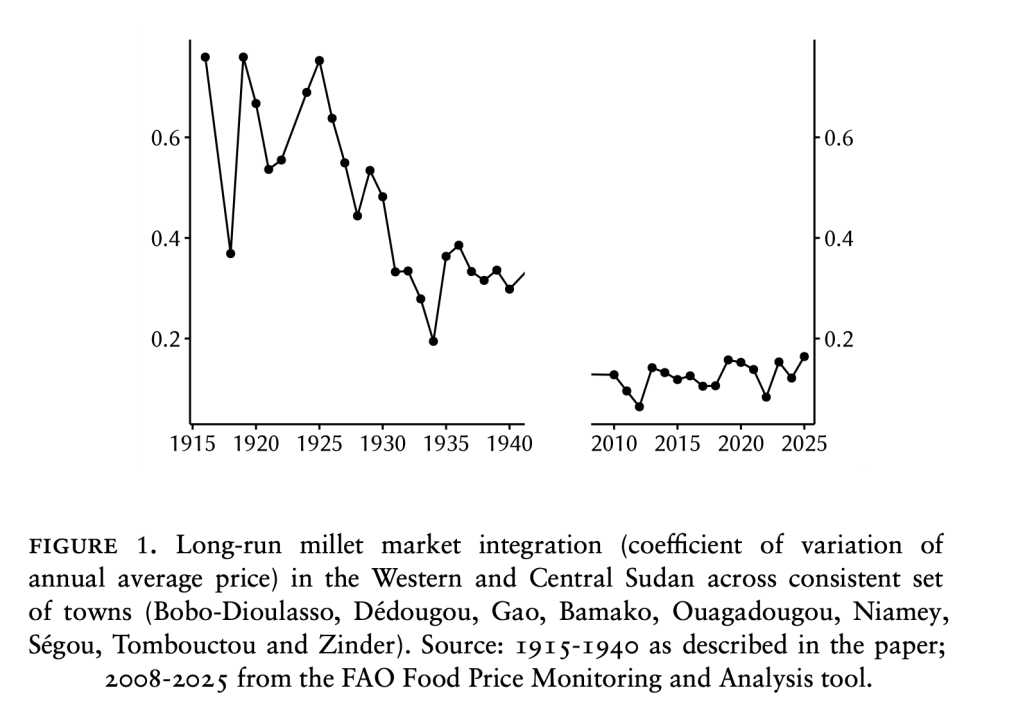
I have a new working paper out at the AEHN series, this time on West Africa. It’s a long time in the making, mainly due to the huge amount of new data it contains, and it constitutes, to my knowledge, the first attempt to quantify the extent of market integration during the colonial period for any part of Africa between South Africa and the Sahara. What I find is considerable integration in grain markets — for rice and salt — over the colonial period, driven by infrastructure investment (intended largely, it should be said, to evacuate cash crops and move soldiers around, not to integrate non-traded staple grains between locations in West Africa.) But I also find an impact from precolonial states, particularly those of the Fulani jihads and of Samori Touré. Price correlations were higher among town pairs that were within these states compared to town pairs that were not.
I have a new working paper paper out with my colleages Ewout Frankema, Michiel de Haas and Tanik Joshipura on the history of maize markets in East Africa, drawing on a new dataset of thousands of maize prices observations we have compiled from primary and secondary sources.
After spending maybe more time than I meant to digging into one of the most popular sources for the econometric history of Africa, I found some time to write up one very small problem with George Murdock’s Ethnographic Atlas and its uses by economists: the ‘focal year’ variable, often used in regressions as a control for the ‘year of observation’ of the data, is not actually a year of observation, and if that’s what you’re using it for, then one of your controls may be measured with error (which, depending on the correlation structure of your RHS variables, may mean that other coefficients are contaminated. Attenuation bias is not the only kind of bias you need to worry about with an iffy dataset!). Here is the draft: comments welcome.
Ok, that’s promising more than I can give, but reading today Paul Guébhard’s account of the Futa Jallon highlands in what is now Guinea in 1910, I discovered his little table that tries quantify the livestock holdings of the Fulɓe pastoralists who lived in the region.
I have been thinking a lot about cattle recently, following the awarding of the Nobel Prize to a trio of scholars who are generally known as “AJR”: Daron Acemoglu, Simon Johnson and James Robinson. In their famous 2001 paper, they tried to estimate the impact of secure property rights on national incomes, on the assumption that the rules that govern property rights are in much of the world inherited from colonial institutions. I don’t want to go into the criticisms of AJR—many others have—but it is interesting to note that in the ‘new institutionalist’ scholarship that was written in their wake, and in particular that fraction of it devoted to Africa, very little has actually been said about property rights per se, and even less about the kinds of property rights that are important for overwhelmingly agrarian economies. (Pseudoerasmus has made this point on BlueSky at much greater depth).
In this respect, it seems interesting to consider the institutions of cattle ownership in tropical Africa (particularly in those areas outside the main tsetse fly zones), since livestock ownership is the major form of wealth in the arid tropics, where land has little intrinsic market value. I am going to try to write a little bit more about the institutions themselves, but for now, I thought it would be interesting to look at one of the consequences of such institutions. How unequal was ownership?
In total, Guébhard estimates a population of around 400,000 cattle in Futa Jallon, divided up between around 44,000 households (representing, he claims, a population of around 280,000 people).
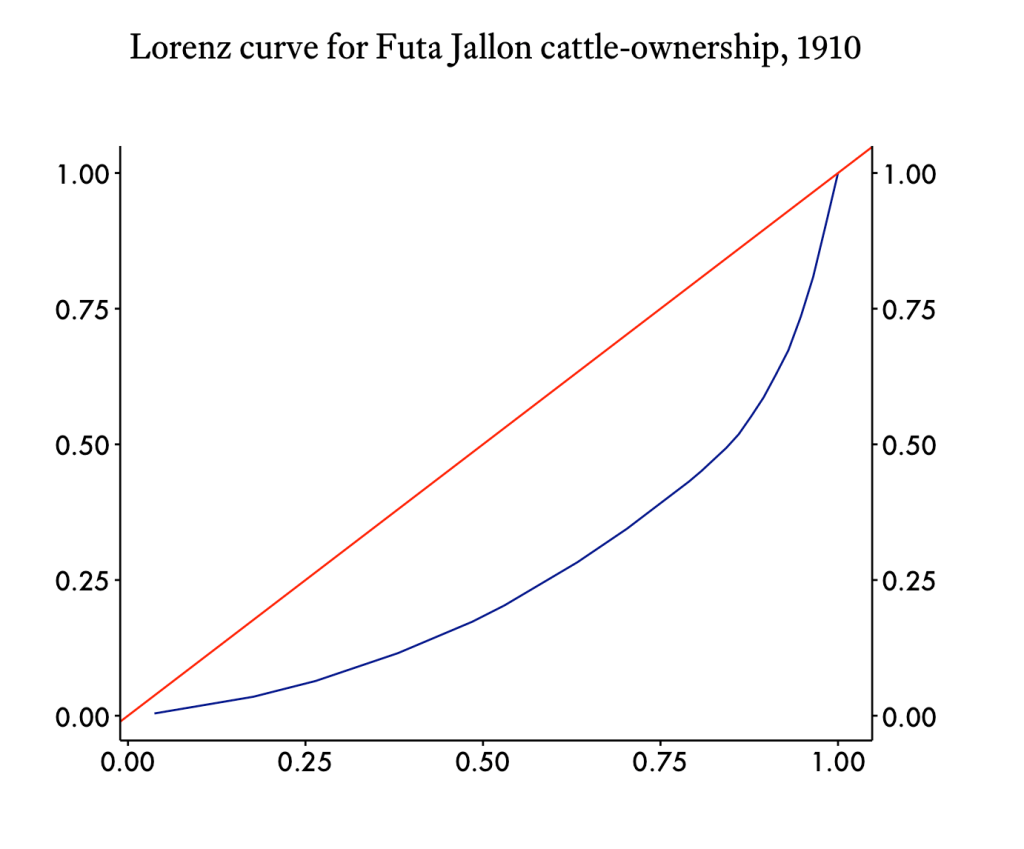
It is a very summary table, and also of dubious precision: for example, the very largest herds of 50 cattle all seem to be owned by precisely ‘780 households’, as do the herds with 49 cattle, and so on until we reach much lower herd sizes. The accuracy of the right hand side of the Lorenz curve is therefore suspect.
Of course, we would want to have much more information than this to build a proper social table for wealth inequality: cattle-owners, as Guébhard notes, were only around 3 in every 11 people in Futa, for example, and we don’t have any information on any non-livestock wealth. But it is still an interesting exercise to plot the Lorenz curve and calculate the Gini.
The Lorenz curve looks like this:
from which we can calculate the cattle-wealth Gini of 0.28.
Without any directly comparable estimates, it is hazardous to make any broad statements about inequality in early colonial Futa. But it’s interesting that this estimate is in the same ballpark as the Gini (note: for income not wealth) of Botswana in the 1920s (the chart from Hillbom, Bolt, De Haas and Tadei’s paper earlier this year in the EHR)—Botswana being one of the most important cattle-owning societies in Africa in this time.
Overall, though, the number seems relatively low, and this may be for several reasons. The first is that mortality was relatively high in Futa, due to enzootic diseases, like trypanosomiasis. Another, though, may be that cattle redistribution is a relatively important feature of Fulɓe societies—and indeed of many pastoral societies elsewhere.
My paper with Emiliano Travieso on the resilience of Northern Nigeria’s textile belt under colonial competition has been published in the latest issue of the Economic History Review.
I’m working on a major new project measuring market integration and food markets in tropical Africa and Southeast Asian in the colonial period, and in particular on the integration of grain and salt markets in French West Africa. Though a great deal has been written both about railways and their impact on the one hand and local trade on the other, there is still a lot of historiographical blanks on the question of the impact of the construction of colonial railways on local product markets. One question I am trying to answer is: how geographically wide were grain markets in Africa? The best way to answer this is to study the behaviour of prices over time, and that’s why I’m gathering as many grain prices as I can, but one interesting metric of trade distance can be gained by exploiting published railway statistics. These will often give tonnage (how much stuff) and kilometric tonnage (how much stuff for what distance). Dividing kilometric tonnage by tonnage gives a measure of the average distance travelled by a ton of produce. Usually, published statistics in sources like the Bulletin mensuel de l’Agence économique de l’Afrique occidentale française give only the aggregate kilometric tonnage for all products, but fortunately, for a few months in 1923-4, we are given kilometric tonnage by product for a number of African railways. (I suspect there are more detailed product-level statistics in the archives, and that’s on my list for my next trip early next year).
As a glimpse, though, the published statistics produce an interesting hierarchy of goods—one that largely accords with what we might have guessed about the spatial nature of trade by product. Of course, lines were of differing lengths, so I’ve also calculated the average distance travelled as a percentage of the total length of the line. Maize, for example, seems to have been transported relatively short distances — 44 km on the Chemin de fer de la Côte d’Ivoire, between Abidjan and Bouaké, and 94km on the Central Dahomey line between Cotonou and Savé, especially compared with long-distance traded goods like salt—141km on average on the Central Dahomey and 252km on average on the Côte d’Ivoire line.
While looking for information on Dakar’s mid-century housing crisis, I came across a little legal story that played out in the pages of the newspaper Paris-Dakar in 1948. This was the year of the death of Alassane N’Dir, a major landowner in Dakar and a prosperous businessman and philanthropist. By the time he died, N’Dir had been an active merchant for over half a century, since starting up in 1895. He first made his fortune trading kola nurs in Côte d’Ivoire. In that colony, N’Dir acquired a portfolio of urban land from early on: in 1906, he purchased a block of 1250 square metres in Abidjan. With a business partner, he had also held property in Bamako, in what was then the colony of Soudan français and is now Mali. But his main property empire was in Dakar. N’Dir was a Lebu landowner: that is to say, he had customary rights over the land upon which a rapidly growing Dakar was build. His name appears frequently in the cadastral register; in the November prior to his death, the newspaper Paris Dakar published a notice saying that N’Dir had registered a property of 44 hectares in what is now the suburb of Sicap-Liberté. He was also very well-connected politically: he was allied with Lamine Guèye, who was a Senegalese deputy in the French parliament. On his death in April 1948, Betty Fall wrote for Paris-Dakar that ‘all of Dakar’ had come out to accompany his body to its final resting place in the Muslim cemetery in the suburb of Médina.
His nephew, Assane Sylla, claimed the role of executor. Sylla published a notice in Paris-Dakar on 19 July advising all of N’Dir’s tenants that Amadou Mboup, who was employed at the Chargeurs Réunis, no longer had the right to collect the rent due to N’Dir, since he was neither related to N’Dir nor had he been authorised to act on behalf of N’Dir’s estate by N’Dir’s descendants. Mboup responded quickly: the following day he took out a notice in Paris-Dakar as well, informing N’Dir’s renters that Sylla had been dishonest, and that he, Amadou Mboup, ‘remained the custodian of the buildings of Hadj Alassane N’Dir’ since the latter’s legal successors had confirmed it in ‘a family meeting’. Consequently, N’Dir’s tenants were, Mboup affirmed, required to pay rent to him, as custodian. On the 21 of July, a party of three men—Bachirou Badiane, Malamine Diol, Ibra Sarr and Abdoulaye Sy—took out yet another notice, stating that they were the duly authorized representatives of Aminata N’Dire, Woré Diagne, N’Dir’s widow as well as Amsatou Sow and M’Bassa Diop (both of whom had borne N’Dir’s children). The confirmed Assane Sylla’s account: as N’Dir’s nephew, he was the sole executor of N’Dir’s will. They further demanded that Amadou Mboup ‘rectify’ the notice he had placed in Paris-Dakar, ‘so as to avoid any legal action’. From here, the newspaper trail goes cold: Mboup doesn’t appear to have published any correction to his claim to collect N’Dir’s rent. (This wasn’t the last time that Alassane N’Dir’s memory would be invoked in a fraud: in 1949, Paris-Dakar carried a notice about someone who ‘called himself the son of El-Hadj Alassane N’Dir’, passing himself off as the heir to the deceased entrepreneur.)
The stakes were high. In the last decade or so of colonial rule in Senegal, house rents in Dakar — and in cities across West Africa — were very high, as I document in this working paper (now revising for publication). Control over N’Dir’s real estate empire in Dakar would have been a lucrative source of income in a city in the throes of a housing crisis. We don’t know very much about housing entrepreneurs, but — as I argue in the paper — more research on their investment strategies may help to understand why investment in industry was so low in many African countries after independence.
In the 1970 world census of agriculture, seven countries asked farmers how they transported their crops to the first point of sale (to a market, or a trader, etc.). All seven countries were reasonably poor (under US$1000 per capita GDP) but it is striking how common transporting crops to market by foot was in the two African countries compared to the South/Central American countries and Jordan (still a low-income country at the time the census of agriculture took place, though it grew spectacularly in the 1970s due largely to remittances). Of course, there are physical differences between the countries — Zaïre was and is about two-thirds of the size of Western Europe. But it does show some of the difficulties faced by agriculture, and particularly export agriculture, in Africa in the twentieth century.
Share of farmers who took their produce to the first point of sale by foot:
I have a new article out at the Economic History of Developing Regions on the British Blue Books, a staple source of statistical information for historians of the British Empire. In the article, I compare the retail prices listed in the Blue Books with market prices collected from African newspapers in the late nineteenth and early twentieth centuries, and show that in some contexts the Blue Books can be an unreliable source for price history.


 Tom Westland